




AI in ecommerce has exploded across marketing, finance, and operations, and accounting tools are no exception. Vendors promise “self-driving books,” “AI CFOs,” and dashboards that think for you. But if reconciling last month’s Shopify payouts still feels like detective work, you’re not alone.
There’s real progress happening in AI in ecommerce accounting, but also plenty of exaggerated marketing. Gartner even places generative AI for finance at the Peak of Inflated Expectations, meaning the buzz often outweighs the capabilities.
This guide breaks down what’s actually working for Shopify and WooCommerce merchants today, what’s still unproven, and how to invest in technology that saves time rather than creating new risk.
What “AI-Powered” Actually Means in Ecommerce Accounting
Not every “AI-powered” tool actually uses AI, and in ecommerce accounting, the difference matters. Some tools automate predictable workflows, while others learn patterns or generate explanations. Knowing which is which helps you decide what’s safe for your financial data and what’s only suited for light assistance.
Here are the main categories:
Rule-Based Automation (The Workhorse)
This runs the most reliable parts of ecommerce accounting: syncing orders, mapping fees and taxes, handling refund logic, updating COGS, and pushing data into QuickBooks or Xero in a structured, error-free way. It’s predictable and accurate, which is exactly what financial workflows need.
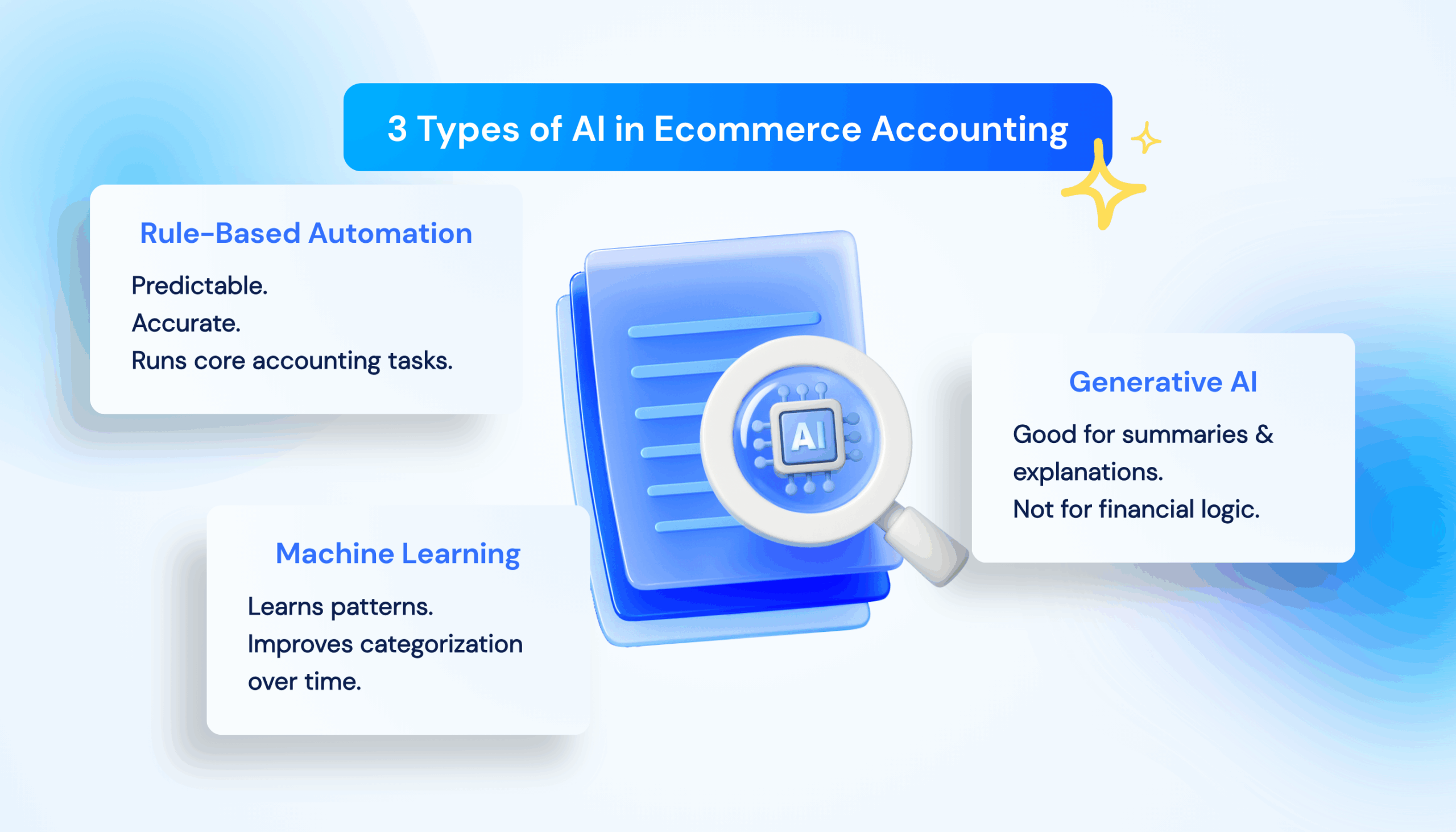
Machine Learning (The Pattern Learner)
ML improves over time, especially with recurring tasks. Once you categorize Klaviyo as a marketing expense or adjust an Amazon FBA fee mapping, the system learns and applies the rule consistently. This is where most practical “AI in accounting” value exists today.
Generative AI (The Creative Assistant)
Generative AI helps with explanations, report summaries, email drafts, spreadsheet formulas, and operational questions. It’s useful, but not suitable for interpreting fee structures, multi-currency payouts, or tax implications. It guesses, and guessing is incompatible with bookkeeping.
Related: What are the Best AI Tools for Ecommerce Businesses?
AI in Ecommerce Accounting: What’s Actually Working Today
Forget the futuristic promises. Here are the three areas where automation is delivering measurable ROI right now.
1. Automated Bank Reconciliation
This is the most painful part of ecommerce bookkeeping because payouts rarely match sales totals. Shopify deducts fees and refunds; Amazon deducts FBA costs, storage, and chargebacks; PayPal applies currency adjustments; Stripe batches deposits at inconsistent intervals.
Modern payment reconciliation tools now match gross to net, identify discrepancies instantly, and categorize the differences correctly. This reduces reconciliation time dramatically. For multi-channel merchants, it’s often the single biggest efficiency gain.
2. Transaction Categorization
ML-driven categorization has matured enough to reliably classify common ecommerce expenses. Whether it’s SaaS subscriptions, shipping carriers, marketplace seller fees, or advertising charges, the system learns from your corrections and gets increasingly accurate. This removes dozens of minor decisions each week and dramatically lowers bookkeeping fatigue.
3. Platform Syncing
This is where automation and AI in ecommerce accounting are most transformative. Reliable syncing keeps Shopify, WooCommerce, Amazon, and marketplaces aligned with your accounting software. It ensures that every order, fee, refund, tax, discount, and COGS update is accurately recorded in QuickBooks or Xero and mapped to the correct accounts.
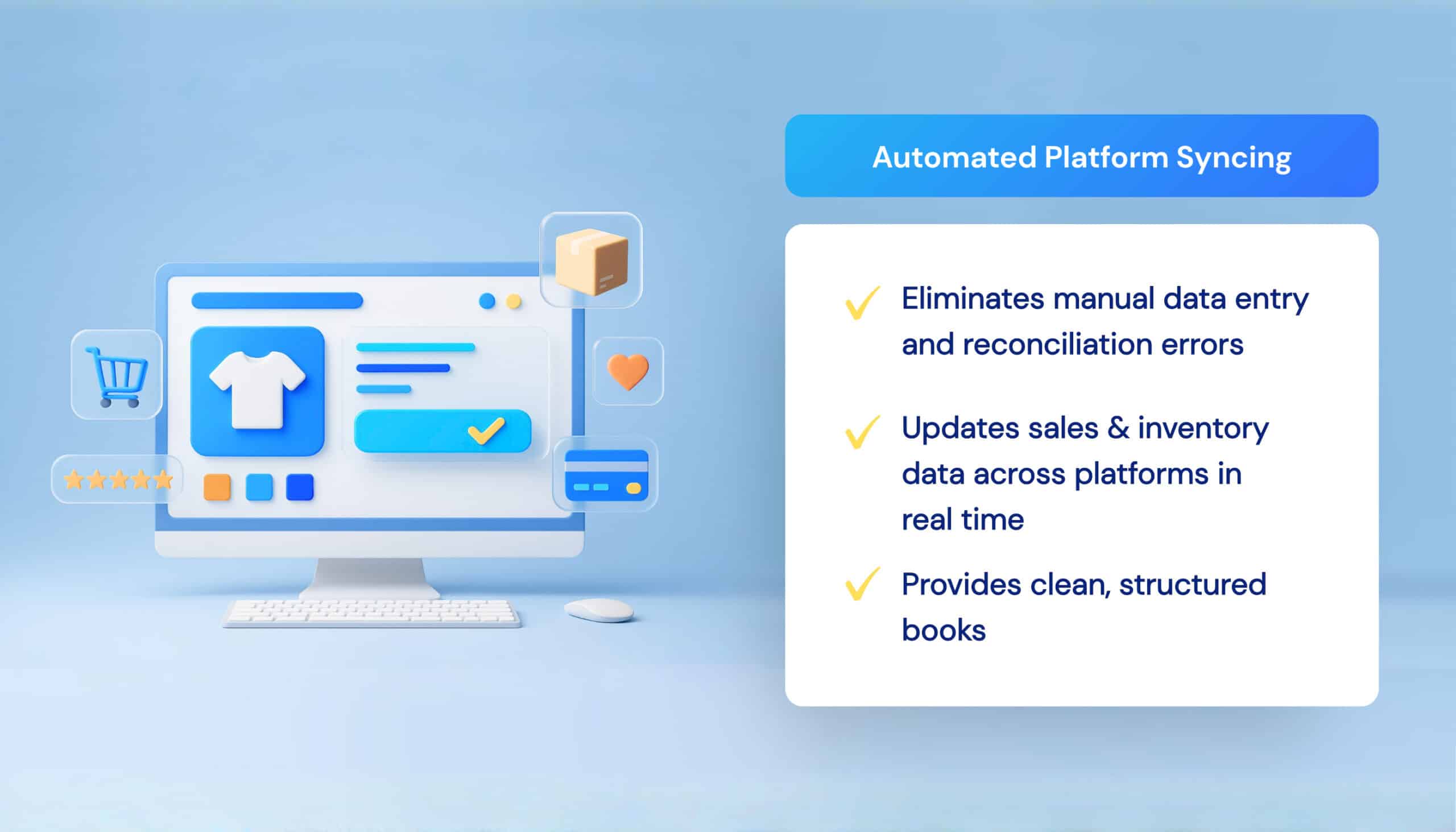
For ecommerce sellers, this is far more valuable than flashy AI insights. It eliminates manual entry, prevents reconciliation issues, and gives your ecommerce accountant clean, structured numbers.
MyWorks excels here by offering real-time syncing that understands ecommerce complexity, not generic rules built for brick-and-mortar businesses.
AI Accounting Claims That Are Still Hype
While automation is powerful, some sales pitches need a reality check. If you hear these claims, proceed with caution.
The “AI CFO”
You will hear pitches for “AI CFO” tools that promise to make strategic decisions for you. Here is the catch: they lack context.
AI can’t:
- Understand your inventory turnover cycle.
- Manage cash flow spikes around sales events.
- Account for Amazon reserve balances.
- Plan tax strategies across jurisdictions.
- Analyze contribution margin with COGS fluctuations.
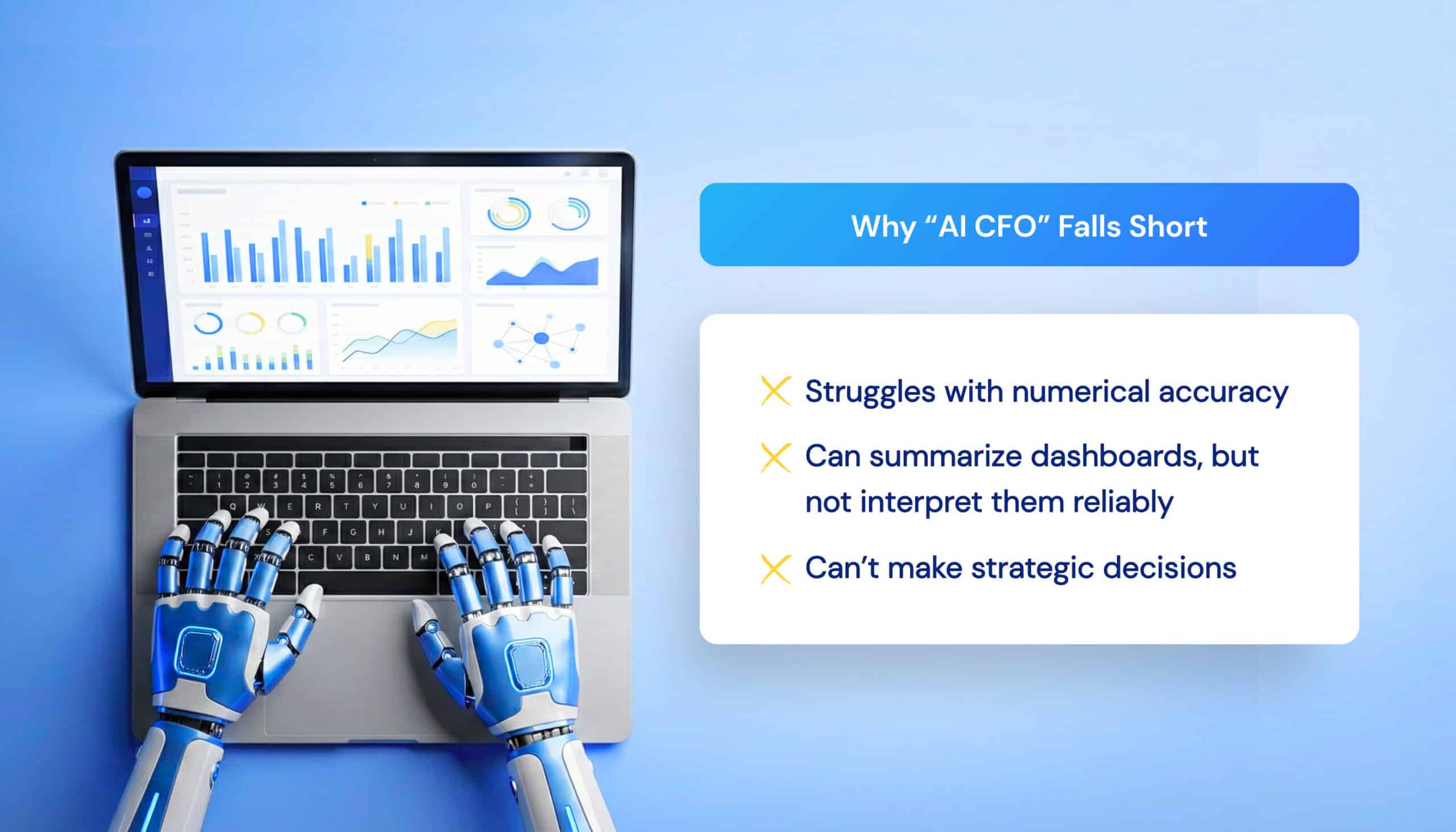
A CFO told Fortune his AI experiments were disappointing because the tools aren’t great at math yet. It can summarize dashboards, but it cannot make strategic decisions.
Fully Predictive Bookkeeping
Predictive systems attempt to:
- Pre-categorize expenses before you review them.
- Forecast cash flow without human validation.
- Guess tax liability or nexus implications.
- “Intuitively” understand marketplace fee structures.
These are risky for ecommerce because:
- Every platform has unique fee logic.
- Refunds and chargebacks break predictive assumptions.
- Multi-currency creates fluctuations.
- GenAI hallucinations corrupt ledgers.
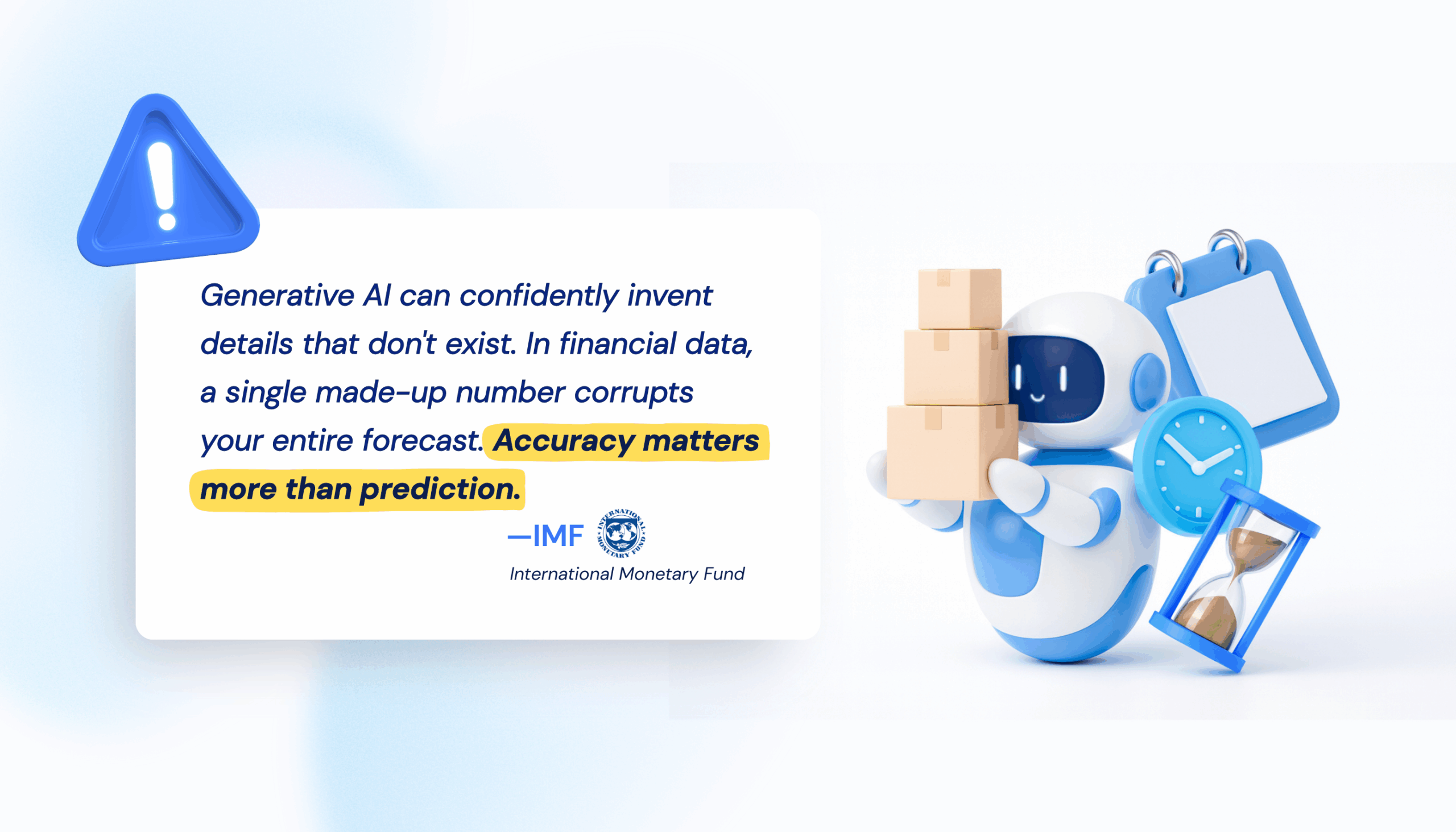
The IMF warns that generative AI can confidently invent details that don’t exist. In creative writing, that’s a feature. In financial data, a single made-up number corrupts your entire forecast. Accuracy matters more than prediction.
“Self-Driving Finance Teams”
Ecommerce accounting involves too many moving parts for a completely autonomous system. Refunds, partial payments, multi-currency settlements, bundle discounts, platform-specific fees, and inventory adjustments all require judgment calls. AI still needs oversight, and reliable automation still needs structure.
TL;DR: AI Accounting Reality vs. Hype
| What’s Real Today (Proven) | What’s Still Hype (Avoid) |
| AI-assisted reconciliation | “AI CFO” |
| ML-based categorization | Fully predictive bookkeeping |
| Real-time Shopify/Amazon syncing | Autonomous finance teams |
| Automated fee/tax mapping | AI replacing accountants |
| Rule-based inventory/COGS syncing | Self-driving bookkeeping |
How to Evaluate AI Accounting Tools
When a vendor claims their software will “transform” your accounting with AI, it helps to look past the marketing and assess what the tool can actually do. Ask these questions to separate durable automation from speculative features:
1. Does the Tool Understand Ecommerce Complexity?
Not all accounting AI is built for:
- Shopify fee rules.
- Amazon settlement formats.
- PayPal multi-currency.
- WooCommerce refund logic.
- B2B invoice workflows.
If a tool doesn’t understand these nuances, it will struggle with the very tasks you need automated.
2. Does it Automate the Inputs, Not Just Summarize Them?
Generative AI is excellent at summarizing dashboards or explaining trends, but summaries don’t clean up messy books. Reliable accounting automation needs to handle the inputs: the orders, payouts, fees, taxes, refunds, and adjustments that determine whether your numbers are accurate.
3. Does it Reduce Manual Work Immediately?
A tool that still requires constant supervision, manual approval, or daily corrections is not truly automating anything. The best solutions should eliminate repetitive work from day one by syncing data correctly, applying consistent rules, and reducing the volume of manual checks.
4. Can It Handle Edge Cases?
Ecommerce accounting is full of exceptions: partial refunds, multi-currency payouts, pre-orders, bundle discounts, shipping adjustments, and marketplace-specific fees. If a tool only works in ideal scenarios, you’ll spend more time fixing errors than saving time.
5. Is it Built for Scale?
What seems manageable at 50 orders a day becomes overwhelming at 200. Because ecommerce volume compounds quickly (200 orders/day becomes 1,400/week and more than 5,000/month), even small inefficiencies can cost hours of extra work. Scalable automation is essential.
Start with automation that solves the hardest problems:
- Syncing.
- Reconciliation.
- Categorization.
- COGS tracking.
- Tax mapping.
Then layer in lightweight AI (chatbots, summaries, drafting tools). For a comprehensive roadmap, refer to our guide on AI workflow automation for Shopify accounting.
Generative AI Chatbots: Where They Fit
Tools like ChatGPT are genuinely useful assistants, but they shouldn’t be your accountant. ChatGPT and other LLMs are excellent for:
- Drafting payment reminders.
- Explaining accounting terms.
- Writing Excel/Sheets formulas.
- Generating SOPs.
- Clarifying workflow issues.
- Answering how-to questions.
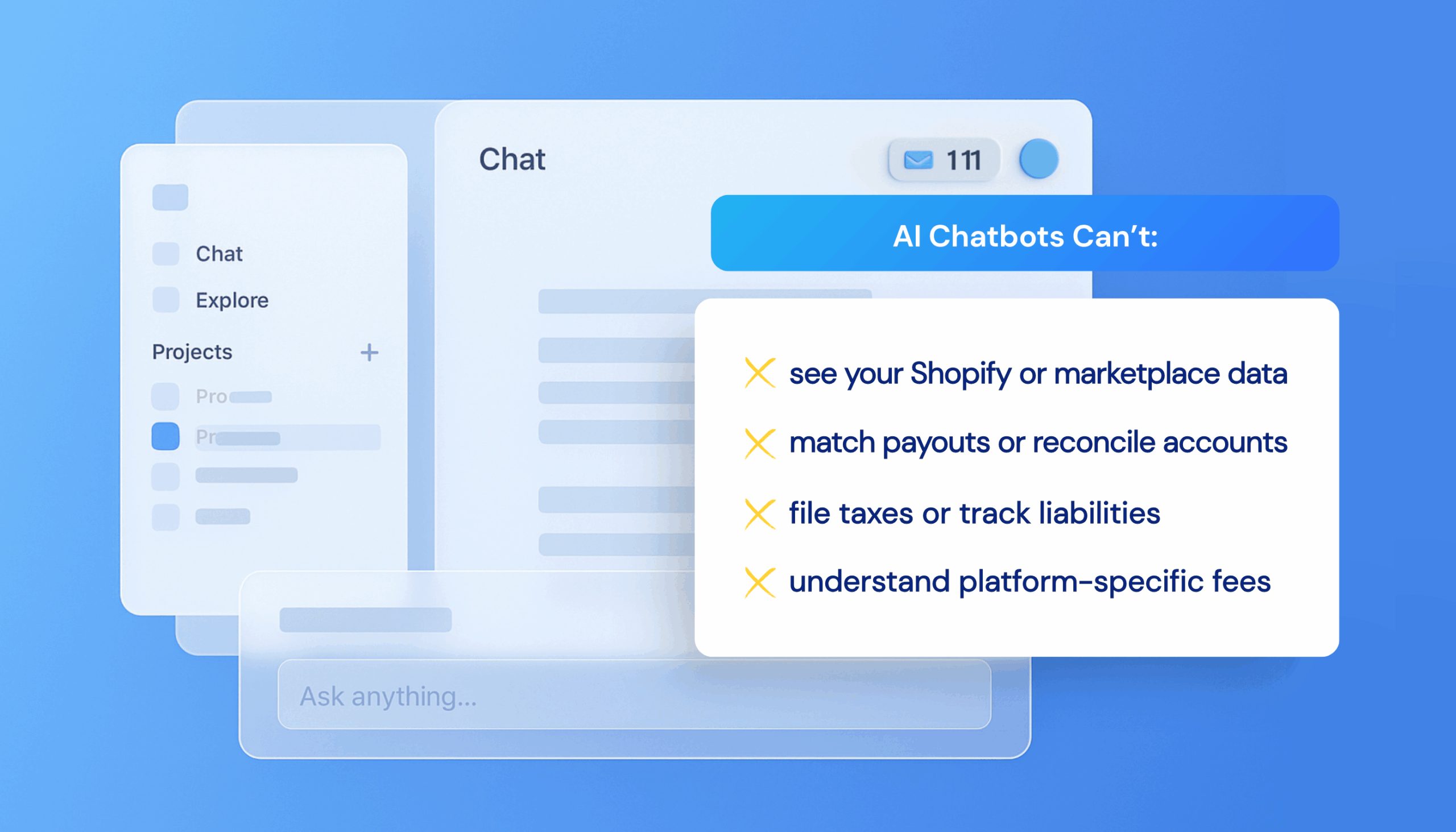
But they cannot see your Shopify data, match payouts, categorize transactions, reconcile accounts, file taxes, or understand channel-specific fees.
That’s why the best merchants use:
- MyWorks: for automation they can trust.
- ChatGPT: for support and explanations.
📌 For Ecommerce Accounting Troubleshooting: use the MyWorks Ecommerce Accounting Hero custom GPT.

Automate Ecommerce Accounting With Proven Tools Today
Start with proven automation before chasing experimental features. MyWorks syncs orders, fees, refunds, and inventory between Shopify or WooCommerce and QuickBooks or Xero, eliminating the manual data entry that eats up your week.
As a Built for Shopify app, an Intuit Platinum Partner, and the official QuickBooks Sync for WooCommerce, MyWorks gives ecommerce brands the clean, structured, and reliable financial data needed to adopt AI safely later.
AI can’t do everything, but with MyWorks, it doesn’t have to. See MyWorks in action and learn how to put your bookkeeping on autopilot.
FAQs About AI in Ecommerce Accounting
1. How is AI Currently Being Used in Accounting?
AI in accounting today focuses on automating repetitive tasks rather than strategic decision-making. Approximately 98% of U.S. accountants report using AI, primarily for transaction categorization, bank reconciliation, and document processing. For ecommerce, the most practical use is automated syncing between platforms like Shopify and QuickBooks.
2. Can AI Automate Bookkeeping?
Partially. AI excels at routine tasks like categorizing transactions and matching bank deposits, reducing reconciliation time. However, it cannot handle complex judgment calls or tax strategy. The best approach is to automate the data flow with the tools MyWorks and let your accountant handle the strategy.
3. Is AI Going to Replace Accountants?
Not anytime soon. Stanford research confirms that AI tools are “mainly used for bookkeeping activities, the foundational, day-to-day tasks.” Complex areas like tax strategy, audit preparation, compliance, and financial planning still require human expertise.
What AI and automation excel at is eliminating tedious work (such as manual data entry, transaction matching, and report generation), allowing accountants to focus on strategic advice that actually helps your business grow.
4. Which AI is Best for Ecommerce Accounting?
Tools built specifically for ecommerce. Look for Shopify/WooCommerce integrations, multi-channel compatibility, accurate fee mapping, real-time syncing, inventory tracking, and B2B workflow support. MyWorks is built specifically for this, connecting Shopify and WooCommerce stores to QuickBooks and Xero with real-time syncing.